
The Hoyer Map:
What Forty Years in District 5 Really Looked Like on the Ground

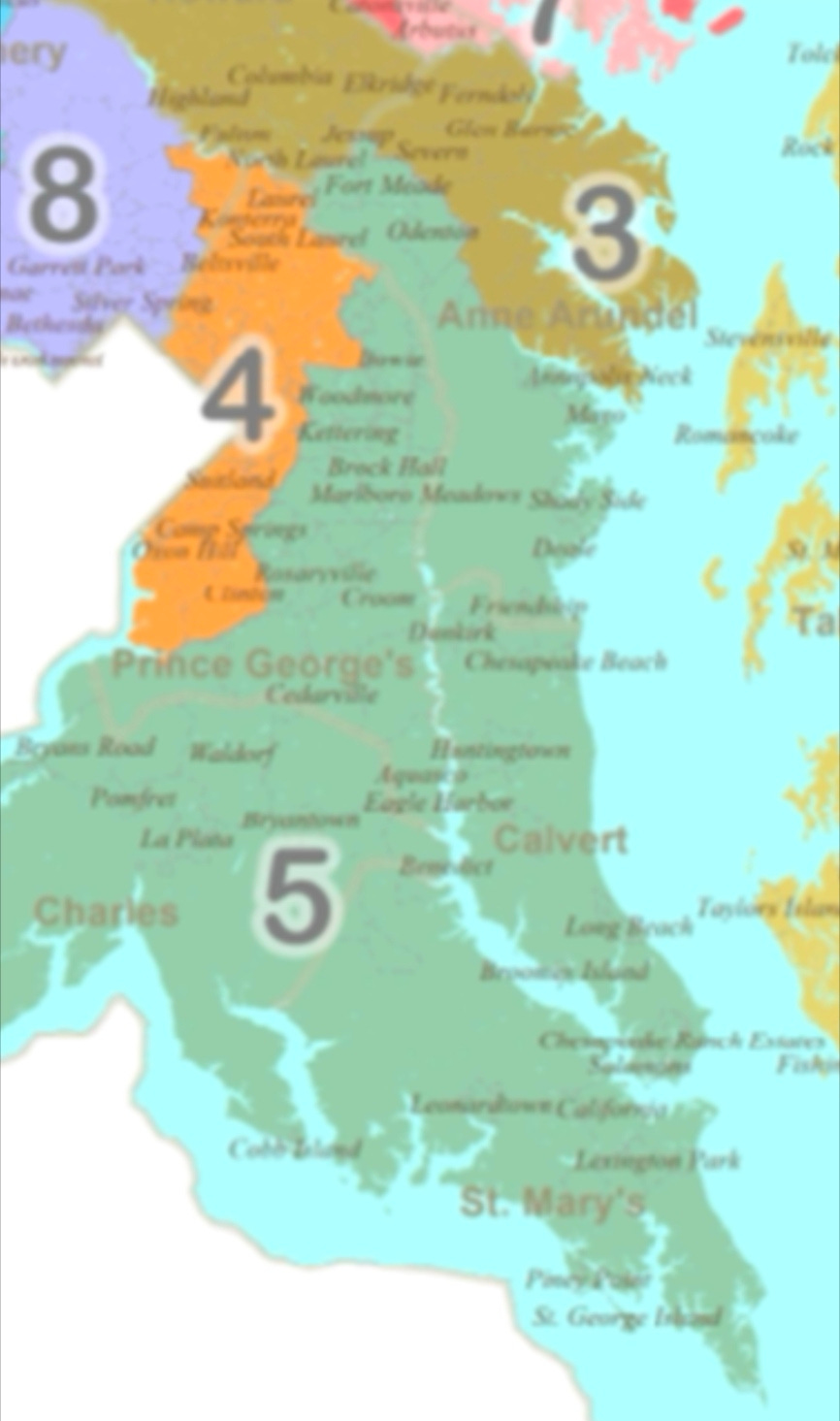
The Hoyer Map: What Forty Years in District 5 Really Looked Like on the Ground
By Barry O’Connell
Every election cycle, especially in the last decade, I hear the same refrain from a certain corner of Prince George’s County: “How on earth did Steny Hoyer keep winning?”
And the people asking this question are never the folks in Waldorf or Leonardtown or Accokeek. It’s always the same cluster — the Lanham–Landover–New Carrollton belt, the urban‑progressive heart of the district, where the anti‑Hoyer sentiment has been loud, persistent, and honestly, pretty sincere.
But here’s the thing I keep telling people:
District 5 was never one district. It was three districts living under one name.
And Hoyer understood that long before anyone else did.
So let’s walk through it — precinct by precinct, culture by culture — and make sense of how one man held a seat through the Mike Miller era, the Obama era, the Trump era, and into the present day.
The Urban Core: Where the Anti‑Hoyer Movement Lived
If you live in Lanham, Landover, New Carrollton, Hyattsville, Capitol Heights, Suitland, or Temple Hills, you probably think the whole district was itching to throw Hoyer out.
Because in your precincts, he was often pulling 55–65% in primaries — which, for a sitting Majority Leader, is not exactly a love letter. His challengers routinely hit 35–45% in these boxes. That’s real opposition. That’s not imaginary.
And this is also the part of the district where the “white support” accusation has the most traction. Not because people dislike white voters, but because in dense urban Black communities, race is used as a shorthand for coalition alignment. It’s a political signal, not a personal judgment.
This is the world where:
- gentrification anxiety is real
- white progressive activism is visible
- machine politics is distrusted
- online political culture shapes expectations
So yes — this is where the anti‑Hoyer movement was born, lived, and organized. And it was loud because it was concentrated.
But it wasn’t the district.
The Inner Black Suburbs: The Stability Bloc
Drive ten minutes east or south — Bowie, Largo, Mitchellville, Woodmore, Kettering — and the political climate changes completely.
These precincts gave Hoyer 65–75% in the last three competitive primaries. Not because they were swooning over him, but because they valued:
- stability
- seniority
- federal clout
- someone who could get a phone call returned
This is the federal‑workforce belt. The contractor belt. The “I don’t need drama, I need predictability” belt.
And the “white support” accusation?
It barely registers here unless it’s tied to developers or law‑and‑order conservatives. Otherwise, it’s background noise.
This bloc alone was enough to keep Hoyer’s floor high.
Charles County: The Quiet Giant
If the urban core was the loudest, Charles County was the quietest — and the most decisive.
Waldorf, Bryans Road, White Plains, Indian Head — these precincts routinely gave Hoyer 70–80%. Every cycle. Without fuss. Without theatrics. Without Twitter threads.
Charles County’s Black middle class is one of the least ideological electorates in the state. They vote on:
- schools
- traffic
- taxes
- competence
- whether the candidate seems like a grown‑up
They are not swayed by online discourse. They are not swayed by progressive purity tests. They are not swayed by “white support” accusations unless it’s tied to developers or old courthouse networks.
This is the bloc that kept Hoyer’s margins comfortable even when the urban core was restless.
Rural Southern Maryland: The Old Foundation
Then there’s St. Mary’s, Calvert, and southern Charles — the part of the district most Marylanders forget exists.
These precincts gave Hoyer 75–85% in Democratic primaries. Every time. For forty years.
This is a world where:
- personal reputation matters
- seniority matters
- bringing home federal dollars matters
- and “white support” only matters if it comes from sheriffs or conservative courthouse networks
This was Hoyer’s original base, and it never abandoned him
The Real Story: Three Districts, One Outcome
When you put all three cultures together, the math becomes obvious:
- Urban PG: Hoyer 55–65
- Inner Black suburbs: Hoyer 65–75
- Charles County: Hoyer 70–80
- Rural Southern MD: Hoyer 75–85
So even if the urban core was shouting “We want change,” the rest of the district was quietly saying, “We’re fine, thanks.”
That’s how you get a man winning primaries with 60–70% while a very real, very passionate opposition never breaks 36% districtwide.
It wasn’t a conspiracy.
It wasn’t apathy.
It wasn’t ignorance.
It was geography.
It was class.
It was political culture.
It was three districts voting at the same time for different reasons.
And Hoyer — whatever else you think of him — understood that map better than anyone.
Why This Still Matters Today
Because the same divides still exist.
The same political cultures still shape the district.
And the same misunderstandings still fuel arguments online.
If you live in Lanham, you hear one story.
If you live in Waldorf, you hear another.
If you live in Leonardtown, you hear a third.
District 5 has always been a coalition stitched together by geography, class, and history. And for forty years, Steny Hoyer was the one person who could speak all three dialects.
Whether anyone else can do that — well, that’s a question for another day.
So 2/3 “rural”. I think that it’s time to permanently retire the word “rural” from the state’s policy lexicon.
It is not modern.
In today’s AI and digital distributed economics the word “rural” is used to keep 18 counties under and disinvested.
Except closed meetings of GECS and groups like the Maryland Tech Council are trying to figure out policy work arounds and legislation to extract the land for data centers in counties that they* have not otherwise invested in or have disinvested in through legacy statutes like PFA 1997.
Where are the republicans?????
Hershey. Bailey. Corderman.
There’s a power block right there. And a modern economics and jobs platform is right up their alley. Time to make your move boys.